Share
Share
Dubai’s Branded Residences Market in H1 2026
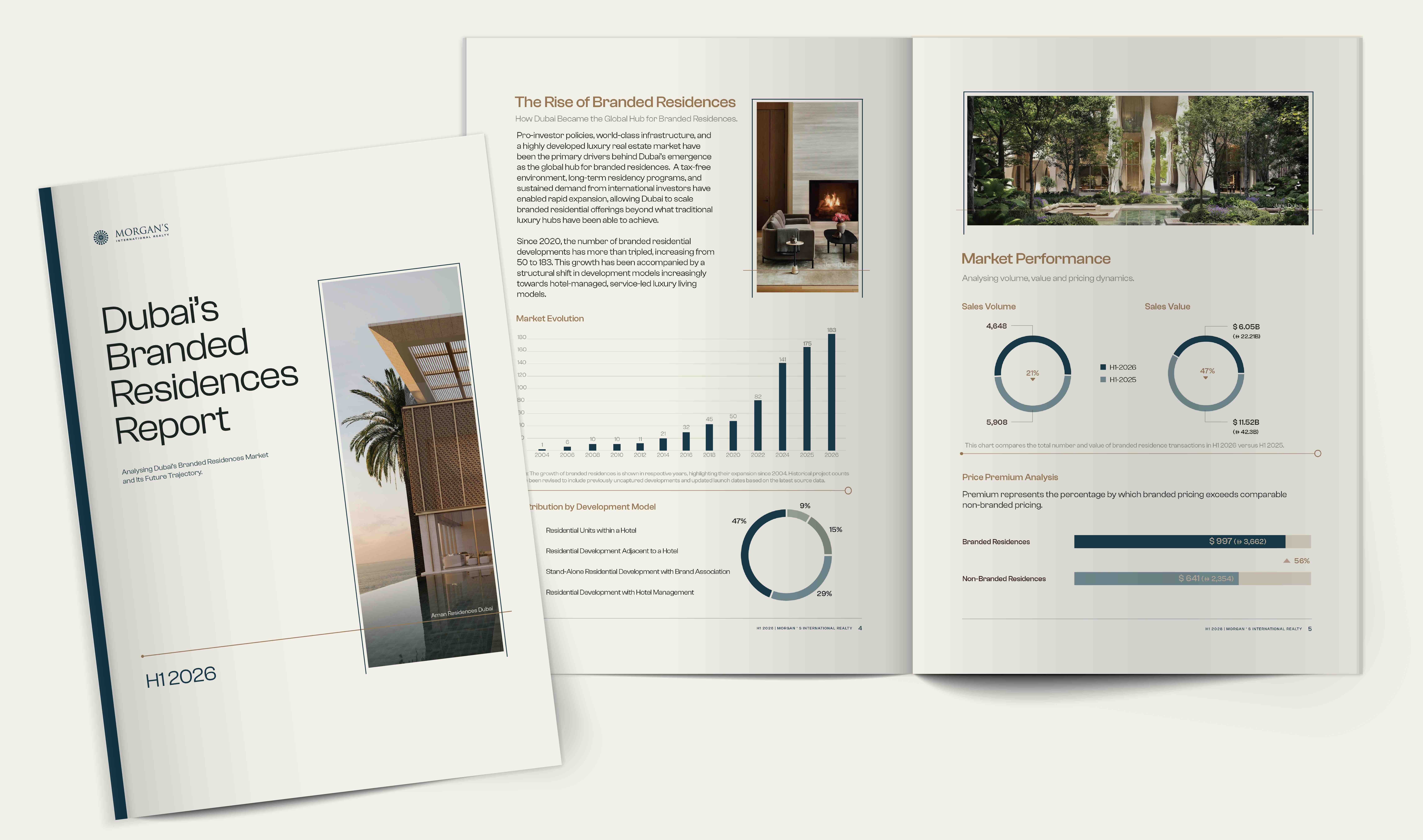
Dubai’s branded residence market continued to expand during H1 2026, adding eight developments containing 5,184 units. Total inventory increased by 8.7% to 64,744 units, while the number of developments reached 183.
Transaction activity moderated from the exceptional levels recorded a year earlier, but the half-on-half comparison was more stable. Average pricing and overall transaction activity remained broadly unchanged from H2 2025, with off-plan sales continuing to drive the market. The H1 results therefore show two market dynamics operating simultaneously: continued expansion in supply and greater selectivity in transactions.
Dubai Branded Residence Inventory Increased by 8.7%
Dubai ended 2025 with 175 branded residence developments and 59,560 units. During H1 2026, eight developments containing 5,184 units were added, taking the market to 183 developments and 64,744 units. Of the current inventory, 115 developments containing 42,826 units were under construction, while 68 developments comprising 21,918 units were ready. Under-construction properties represented approximately 66% of all branded residence units.
The addition of more than 5,000 units in six months demonstrates the pace at which branded residential supply is expanding. It also raises the competitive threshold for new projects entering the market. As supply grows, brand affiliation alone becomes less sufficient as a point of differentiation. Pricing, development quality, delivery, services and long-term operation will play a greater role in determining relative performance.
Transactions Shifted Towards Smaller Units and Lower Ticket Sizes
Dubai recorded 4,648 branded residence transactions worth AED22.21 billion in H1 2026.
This compares with 5,908 transactions and AED42.30 billion in H1 2025, representing a 21% decline in transaction volume and a 47% decline in total sales value. The sharper decline in value was driven by a shift in transaction composition. H1 2026 activity was weighted more heavily towards smaller units, lower transaction values and non-prime inventory than during the exceptionally strong first half of 2025.
The result does not indicate a uniform decline across every part of the market. It reflects a different mix of properties being sold.
H1 2026 also coincided with heightened geopolitical uncertainty across the Middle East. This provides relevant context, although market performance cannot be attributed to a single external factor. The half-on-half comparison was more stable. Relative to H2 2025, average achieved pricing and overall transaction activity remained broadly unchanged. The market therefore moderated from a particularly strong annual comparison while maintaining a similar level of activity to the preceding six-month period.
Foreign Investors Continued to Support Off-Plan Branded Residence Demand
Under-construction branded residences recorded 3,790 transactions during H1 2026.
This represented 82% of total transaction volume and 78% of sales value. Ready properties accounted for the remaining 858 transactions. Off-plan activity continued to be supported by foreign investors entering the Dubai market.
Newly launched inventory gives international buyers access to a wider range of unit sizes and entry prices. Construction-period payment plans also allow buyers to spread capital commitments across several years rather than funding the full acquisition at the outset. This structure has made off-plan branded residences an accessible route into Dubai’s luxury property market for new international investors. However, the reliance on payment plans also creates an important future test. As projects approach completion, their performance will depend increasingly on final payment capacity, delivery quality, leasing demand and resale liquidity.
Market Activity Was Concentrated Around Major Branded Residence Launches
The five leading communities accounted for approximately 59% of all H1 branded residence transactions.
Meydan ranked first with 1,378 transactions, followed by Downtown Dubai, Dubai Creek Harbour, Dubai Maritime City and Dubai Hills Estate. Concentration was even more pronounced at project level.
Mercedes-Benz Places | Binghatti City recorded 1,216 transactions, representing approximately 26% of all branded residence transactions and 32% of under-construction volume. The scale of this project had a material effect on the citywide figures.
This distinction is important. Strong headline activity does not imply that transactions were distributed evenly across the market. A limited number of high-volume launches accounted for a substantial share of reported performance.
As the pipeline expands, separating broad sector demand from project-specific launch activity will become increasingly important.
Dubai’s Branded Residence Price Premium Reached 56%
Average achieved branded residence pricing stood at USD997 per ft², compared with USD641 per ft² for comparable non-branded properties. This represents an average price premium of approximately 56%. The global branded residence premium generally stands between 30% and 35%, placing Dubai materially above the international range.
The result demonstrates the pricing strength of branded developments in Dubai, but a premium of this magnitude is not automatically positive.The gap between branded and non-branded pricing is widening. This raises questions about whether entry prices across every branded project are supported by product quality, services, operational capability and long-term resale demand.
A wide premium can be sustained where a development offers genuine scarcity, superior design, credible management and a differentiated ownership experience. Where the brand proposition is not supported by delivery and operations, the same premium may create greater exposure to price resistance after completion.
The next phase of the market will therefore test not only whether developers can achieve branded premiums at launch, but whether those premiums can be preserved in the ready and resale markets.
Trophy Branded Residence Transactions Remained Active
Five of the largest transactions recorded during H1 2026 achieved values of AED200 million or more. The highest was a six-bedroom residence at Aman Residences Dubai for AED422 million. A second Aman residence sold for AED356 million, followed by Jumeirah Asora Bay Ocean Mansions at AED350 million, The Alba Residences at AED226 million and Bugatti Residences at AED200 million.
These transactions are not representative of the broader market. Their significance lies in confirming continued activity in highly scarce properties at the top of the sector.
The Largest Branded Residence Brands Were Not the Highest-Priced
Address had the largest branded residence footprint in Dubai, with 15 developments. Vida followed with 10 developments, while Palace, de GRISOGONO and Dorchester Collection each had eight. The highest achieved prices followed a different order. Aman recorded the highest average price per square foot, followed by Bulgari, Bugatti and Atlantis.
The distinction reflects two different brand strategies. Some brands have built broad market presence through multiple developments, while others have remained concentrated in a smaller number of highly priced properties.
Neither scale nor achieved pricing determines investment quality independently. Brand-level averages must be considered alongside transaction sample size, development mix and location. An average based on a limited number of trophy transactions is not directly comparable with a brand represented across several developments and price segments.
Outlook: The Next Phase Will Test Pricing and Execution
Dubai’s branded residence market expanded during H1 2026 despite lower year-on-year transaction activity.
Inventory increased by 5,184 units, off-plan properties accounted for most transactions and foreign investors continued to be attracted by new launches and construction-period payment plans. The sector also recorded an average premium of 56%, materially above the global range of 30–35%. These results confirm the strength and scale of Dubai’s branded residence market, but they also introduce clear points of scrutiny. Activity was concentrated around a limited number of major launches. Transactions shifted towards smaller units and lower ticket sizes. The pricing gap between branded and non-branded properties widened beyond international norms.
For buyers, the central question is not whether branded properties achieve higher prices in Dubai. The data show that they do. The relevant question is whether an individual development offers sufficient quality, service, operational credibility and scarcity to sustain its entry price.
For developers and brands, launch pricing must ultimately be validated by the completed product and the depth of the resale market.
Dubai’s branded residence market has achieved scale. The next phase will test whether pricing is supported by delivery and long-term performance.
Download the Full Report